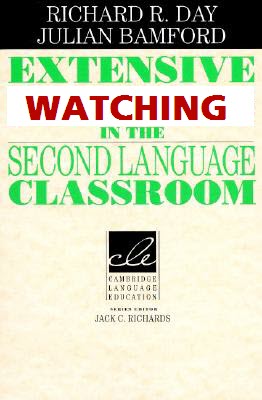
Extensive Watching

The last few years, I’ve been very focused on the role and possibility of video in the classroom. Thus, my recent work developing EnglishCentral and my focus on the potential of a “Flipped Classroom“.

I had an interesting skype discussion with Dan Soriano (@danhummsoriano ) at the BC in Mexico City. He’s thinking of adopting a Flipped Classroom model as an experiment. During our discussion I returned to a term I’ve used over the years, “Extensive Watching“. I’d like to outline this important concept for language learning here and get your own feedback, opinion, thoughts.

I’m a big fan of extensive reading. It works. If done properly, it allows students to acquire a lot of fluency quickly (so long as equal attention is paid to speaking). However, the rub these days is that many students don’t want to nor like reading. It’s just a fact that I’ve run across time and time again in the classroom. I think it has to do with;

a) Visuality being an ever present force and medium now – through the internet, TV, film etc…

b) Communication. Youth are so connected, never alone and a book entails the place and discipline to be alone with self. Today’s youth want shared experience, a social experience. A book is in their head, the images in their head – something is never shared. A film / video has an objective visual reference and is more shared/social.

As I’ve outlined before, the Gutenburg Galaxy is waining. The role of text is taking a back up role to the cool medium that is the visual realm. This entails a change on the part of teachers. We should now update Day and Bamford’s classic and call it “Extensive Watching“. I took down the book from my self and revisited it. It can simply be re-written for this new media focus.

Students “watch” at their own level and through this massive watching of video with language in context, can, do, will achieve rapid language acquisition. That’s where EnglishCentral is coming from but it could be any source of video that is at the appropriate level for the student and contains motivating, interesting content.

I looked at pages 7-8 of the book, “The Characteristics of Extensive Reading”. I hereby end and hand the torch to Extensive Watching by rewriting this to outline the characteristics of extensive watching (and in a future post, I’ll outline the differences, however obvious, with the “extensive listening” approach).

The Characteristics of Extensive Watching

1. Students WATCH as much as possible. (preferably outside of the classroom – following the flipped model of the language classroom)

2. A variety of videos/film is available in a variety of genres and topics so as to encourage watching for different reasons and in different ways.

3. Students select what they want to watch and have the freedom to stop watching when the video fails to interest them.

4. The purposes of watching are related to pleasure, information and general understanding. The purposes are determined by the nature of the videos and the interests of the students.

5. Watching is its own reward. There are few exercises after watching and only for quickly reinforcing the material.

6. The videos are well within the linguistic competence (level) of the student. Video gives context and allows for a “wider” leveling. Dictionaries are used after the viewing and rarely during the watching of the video. Subtitles in the L2 may or may not be used depending on the objectives of the learning.

7. Watching is both shared and individual. Videos if possible, to be discussed and used as scaffolding material into purposeful communication and speaking practice.

8. Watching speed is at the natural rate of the media’s speakers. Whole watching is the recommended practice rather than stopping and reviewing video.

9. Teacher’s orient students to the goals of the program (communicate the rationale), explain the methodology (how to) and track what students watch, and guide students to get the most out of the program.

10. The teacher is a role model and watcher. They participate and watch what students watch. The extensive watching classroom is a place of equality and a decreased power dynamic between teacher and learner.

To wit:  Extensive Watching works and fosters student self learning and monitoring. It also has the added benefit of having pragmatic features of language (body language, postures, gestures etc…) that help the learner immensely (think of how a baby “makes meaning out of sound”).

4 Keys to learning English: input, input, input, noticing

insideheadI’ve written a lot about Krashen’s ideas on this blog. Fundamentally because they focus so well on what is “essential” in language learning. He doesn’t suffer fools gladly and I’m glad about that.

I was going over his online articles and especially his seminal work – Second Language Acquisition and Second Language Learning. I kept coming back to the feeling I had as a teacher – that comprehensible input was what students needed – needed to be engaged, on task and effectively learning a language. Not memorizing, not manipulating words, not learning grammar rules, not translating, not x or Y or z but only input, input, input – at a comprehensible level.

This is why extensive reading is so powerful in helping students acquire a language – but extensive listening is just as powerful yet so seldom done effectively. We need more of that – I’m trying my best at EnglishCentral to make this happen through authentic (but leveled/supported) content.

However, input really isn’t all that must happen when a student receives language. They also have to “notice” the language in their conscious mind. That’s when the learning happens and language “sticks”.

Krashen has a nice little article where he calls this “The Din in the head” hypothesis (and yes, yet another hypothesis). It is kind of like the ghost inside the machine. Meaning, when language is received, there is a “din” that goes off which links the input to something “there”. Scaffolding is achieved and the language rooted when the language is put into a context. What is this “din”?

Essentially it is the student’s bell/brain sparking and going off. An involuntary mental rehearsal of the language. Students notice language. They are no longer fish in water but fish that know they are in water! They take the received and convert it to something and somewhere that it can be produced. It may be relating the incoming language to a known form or L1. It may be repeating it. It may be thinking a thought of something it relates to. It may be a lot of things this din – but it is important. Everything isn’t just input – there has to be some ghost in the machine doing its thing.

Here’s what Krashen says,

“The Din in the Head hypothesis claims that the din is the result of stimulation of the language acquisition device, a sign that language acquisition is taking place (Krashen, 1983).I noted that the Din experience correlates with less reluctance to speak the language, but did not make any hypothesis about a sudden “critical stage” that leads to a “sudden and massive restructuring” as de Bos claims (p. 173). ”

So what does this mean for the working Joe teacher?

I think it means that we have to create curriculum that is contextualized strongly and thus offers “comprehensibility”. I think it means we have to think more about the input that happens in our classes and how we can create regularity of it. I think we have to think about how we might get our students to do some metacognitive activities and start practicing “thinking about language”.

I know it is a long shot but maybe we can try to get this “din” activating more often in our students?

To end. Here’s a screencast I made of the new EnglishCentral “hidden task” feature. Basically a listening cloze activity. I think this kind of activity can support our efforts to activate this “din inside the head”.