This morning, sat down and had some “my time”. Went through a number of my hundreds of notebooks full of philosophy, essays, poems that I’ve been collecting over 4 decades. A lot of stuff buried in these books but was surprised to pull open about 50 pages on film. Don’t even remember writing this but it was fascinating. One part was on Dogme, when it was a new approach to film making in the 90s.
It got me thinking about Dogme ELT something I think is often misinterpreted by many teachers. It also is sort of misnamed – if Dogme ELT were to follow the original Dogme manifesto, it wouldn’t ever take place in a class but only use original settings for practicing language. For example, if you were learning about ordering food, you’d do so in a restaurant. The classroom would be anthema for anything but learning metalanguage (language we use to talk about language).
To me, Dogme ELT is about two crucial things:
1. focusing class activities around the language of the learner and the resulting emergent language (it is highly personal)
2. little or no use of materials (textbooks, worksheets, cards, tapes, computers etc…)
Too often I hear teachers talk about Dogme ELT like it is just going into a classroom and chatting up, running with anything that happens. I don’t think this is what it is about and that approach would be Hangout ELT. In Dogme, the teacher needs to be very experienced in language teaching and interpreting the language of the learners – so they may guide them towards better use and form of that language .
So find below two things.
1. My rewrite of Dogme ELT imagining if it followed the original Dogme 95 manifesto
2. My notebook entry from the 90s about Dogme, rewritten to apply to Dogme teaching.
Might spark some thought about new possibilities with our lessons and in our classrooms.
All teaching and practice of language must be done “in situ”, in the real location. No fake props or sets but only using real language in a real location.
Teaching is holistic. There must be no separation of function and form and language is treated not in discrete parts, nor dissected but rather as it is used.
Technology must be simple and hand driven. Chalk, pencils, pens etc…. No use of electronic devices; computers, screens, CD players and so on. The speaker, the human being, is the focus.
Teaching must be real. It can’t be a play, a scripted event. The plan is that there is no plan other than the main objective to start things off. No fakery, no lying on the part of the teacher.
Extrinsic motivators are forbidden. The class must not be tainted by point systems, rewards and competition.
There should not be any role playing in the classroom (this is artificial). All language takes place and arises from a real need and impulse.
No use of video to show learners language used in a different time and place. It all happens in the here and now.
The teacher can’t be an actor or use different teaching styles. Nor are there any different types of English to be taught (business, global studies, finance, hospitality and tourism etc…). The only English used is that of necessity that comes from the learner, there is no imposed structure given from the instructor.
The class must be 10 or less students to facilitate real use of the language and proper instructor intervention.
The teacher is part of the class and a learner. Credit goes to the whole class for any success, not just the teacher.
Dogme Teaching – A revisiting (rewriting for education/teaching of what I originally wrote about Dogme film, substituting “teaching” for references about cinema)
Dogme?! Everyone is talking about this manifesto, a new and amazing approach to teaching. What a crock! There is nothing new there, it is all fluff and puff. It is only “style”, how a woman might choose a scarf for her walk. Dressing up. The form of teaching shouldn’t be an absolute, a funnel but open and expansive, a way to more things. Dogme teaching is a way for some but we shouldn’t think that anything about teaching language is a MUST. Nothing is sacred and there are many ways to touch that special place where learning happens.
But even if we accept this new form, this new approach as being new, it certainly isn’t revolutionary or transformative. It hasn’t any developmental gravity, it takes teaching nowhere. It only leaves so much on the cutting floor. It simplifies but at a cost. We don’t realize it but we all bring so much cultural baggage into the classroom – there must be desks, a chalkboard, students as an audience, 40 minutes ……. Dogme teaching is just another system and jailing – as all ideological, school and teacher led learning must be.
Even now, this late in the day, a blank sheet of paper holds the greatest excitement there is for me — more promising than a silver cloud, and prettier than a red wagon.
- E.B. White
I’ve just returned from “a return” to nature. Hiked 30 hours through Killarney Provincial Park. Amazing mountains, nature, wild. I suffered and was “with myself”. No gadgets or wifi. Just my mind and foot after foot after foot step.
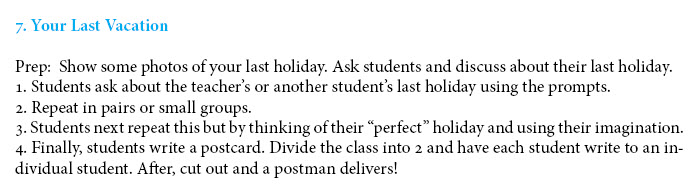
In teaching, I don’t always go with technology. I’m a big fan of just using a blank piece of paper and having students create content. My Teach | Learn coursebook is full of examples of this and is built on the back of my “blank piece of paper” philosophy.
Language to be practiced, just needs a focus. The teacher provides this and then delivers content so the students are prompted to produce language around the topic. I outline many activities in this Wiziq Online session demonstration I did a number of weeks ago. Also, see my Lessons in a Can #57 – #60 for many downloads and descriptions of “a blank piece of paper” activities.
But I thought it would be handy for other teachers to list here the possible lessons you can do with “only a blank piece of paper”. So here it goes. (update: Now get this as a “50 list” here.)
1. Vocabulary discussion: brainstorm vocabulary or write it on the board. (ie. names of family members). Put up the target language structure (ie. Who is ______? ________ is my _______ ) Students ask / answer questions to the teacher and then the same in small groups with their own list on a blank piece of paper. Can be done with any vocabulary word bank and target language.
2. Vocabulary Guessing: brainstorm vocabulary or write it on the board. The teacher describes one and students guess which it is. Continue until all guessed. Students then brainstorm vocabulary set words on a blank piece of paper and play again in small groups. Works wonderful for celebrities!
3. Bookmaking. fold a piece of paper, make a book. Draw pictures and write sentences for any topic. Great for closing a unit and consolidation.
4. Grammar Poems. Do one first as a group, then students do their own. For any topic. Then get them presenting their poems.
5. Categories. Students use a blank piece of paper as a graphic organizer. Fold in columns or rows and then categorize brainstormed vocabulary. (ie. food. Cheap / Expensive / Healthy / Unhealthy)
6. Alphabet lists. Students are given a time limit and must fill in boxes for each letter of the alphabet. Most words got, wins! Fold the paper to make the alphabet organizer.
7. A Piece of paper as a slate / answering board. Make any game interactive and have all students answering by laminating blank pieces of paper and giving students markers. They write answers and everyone answers by raising their answer board.
8. Pass the Paper games. A game I adapted/invented. Students pass around a piece of paper and when the music stops, the others must tell the person with the piece of paper to do something or ask them a question which they must answer.
9. Drawing and labeling. Students draw an object (ie. car) and then label the object on the piece of paper.
10. Posters and projects. Students make posters with important information about a topic/theme.
11. Student made worksheets and wordfinds. Give students a blank piece of paper and let them make the exercises and worksheets! They are experts and have probably done many. They learn a lot through this method/approach.
12. Writing prompts. Give students a prompt. They write for “x” minutes on a blank piece of paper. Or prompt and have the students write only one sentence, fold over and pass on. Continue the writing chain and read the funny version at the end.
13. Snowball fights. Write 3 sentences about yourself. Crumple up and have a snowball fight. Pick up the snowballs, uncrumple and guess who it is!
14. Storyboards. Fold a blank piece of paper so you have 8 boxes. Students draw pictures and write sentences to make a storyboard.
It’s Sunday a day of repose. Re – Pose. Re Position.
If there is one thing in my life I’ve done well – it is to “dance to the beat of my own drummer” a la Thoreau or that other great quote of Blake’s, “No bird soars too high, if he soars with his own wings”.
It’s something I’ve insisted upon as a teacher and more so as a teacher trainer. We are all to create our own methodology and best practices. Not that we ignore the advice of others but that we use it and smudge it to form our own teaching collage.
English language teaching and too our commercial driven lives, is full of “the new, best thing”. Do not be entranced by snake oil salesman. Do not offer blind allegiance to anyone. Be they a Nunan (tasks), Krashen (input), Thornbury/Meddings (Dogme) or a whole flock of others. These are only “ideas” and we know so little about second language acquisition that we’d be so wrong to bet “All In !”. I say that with the most respect to those offering up new approaches and methods. Same goes for a textbook or a technological approach. They aren’t to be blindly implemented – rather, follow your nose.
Same with the flip side of the coin, learning a language. Some will benefit from intensive memorization of vocabulary, some will need a lot of extensive listening. Others benefit from reading. Find what works for you and stick with it – until it is time to “reposition”.
Beware of systems. Ideologically or as part of your teaching beliefs. Questions, criticize and adapt to your own teaching style and classroom/school environment. Same goes for teaching certification and training. A CELTA is one way of teaching English. So too your own trainer’s approach and instruction. Even the hallowed “CLT” or communicative approach is just that – a suggestion. There is nothing proven in terms of efficacy. We are human and that’s the rub and difficulty. There is nothing foreign to us – in terms of learning.
The best teachers weave and dance to their own music. They make magic happen, learning happen, precisely because they are not “tunnel visioned” but adapting and testing, trying and changing. No guru, no method, no teacher – like Van the Man said.
Just like spring, always be ready to begin anew. But stronger, given the knowledge and experience gleaned from one more winter…..
This video opens the door into the actual practice of the flipped instructional model. (not a language classroom but think of what it would mean for one). A very interesting way to think of “teaching”. Basically, it means for ELT that the heavy lifting, the explanation and focusing on form is consigned to the language lab, to self directed learning, to homework (videos of the teacher/a teacher teaching stand and deliver style). The classroom becomes a place where time is spent using the language socially, testing, risking, trying …… This is a little different than the Flipped Model for content subjects.
I see the new nature of learning as following not just a blended model but a “Flipped” model. David Truss has written a real nice summary of this. Classrooms become laboratories and places of practice. Content delivery is outside the classroom in an either formal or informal environment. Teachers no longer teach in the classroom. They teach in the sense of arranging content, mixing/blending and then delivering it for student consumption outside of class. In class, students practice what was “digested”.
For ELT this means that classroom instruction just skips the “Prepare” and “Practice” stages (or “Engage” / “Study”.). The old instructional delivery models are wiped away and the classroom is about students coming together to practice and perform tasks based on their learning outside the classroom. The teacher deals with emergent language “in situ” and corrects/remediates as needed, on the spot.
The flipped classroom is perfect for those teachers already familiar with task and performance based curriculum. Much like “station” teaching also. However, more unstructured and when students come to the classroom – they are making the choices about what they will practice.
For many teachers though – it will entail a lot of “letting go”. Read this Ira Socol piece and wonder about your own classroom “design”. So too for publishers, who will have to provide books and online materials not tailored to the question 1,2,3 Speak / Grammar / Practice / Pronounce / Read / Write models they use.
This video – The 21st Century Learner is a must watch for any teacher trying to understand the direction and implications of new “disruptive” technologies. The classroom no longer has 4 walls and learning is taking place outside the classroom (informally) through social media and “connected” learning.
It will be out next week but thought it would be interesting to some, to see a sample lesson and to get a few thoughts about the delivery of this lesson and the use of the course book.
Here is an example lesson. All 36 lessons are like this one and have the same methodology more or less. I’m using a lesson I showed previously, so you might also see how this book has developed and been designed.
Basically it goes like this:
Page 1: Whole class. A student or teacher is at the front of the classroom and is the focus of the target language. The activity is completed (see Teacher’s Notes below, which are for each lesson in the back of the book). This gets students comfortable with the target language and prompts background knowledge and schema.
Page 2. Pairs / Small groups. Students do the same but with their own language, questions, input, experiences. There are multi media materials to click which both teacher or student can use to reinforce, repeat or complement the lesson.
I’ll have more tomorrow about the rationale for this methodology. Go here for some more thoughts on my own beliefs/process in creating this course book.
I have written and pounded the pulpit long and hard on the issue of teachers “getting out of the way”. Ranted and pleaded with teachers to be more inductive in their approach, more sandbox about the learning environment.
No greater compliment to my own constructivist and technology enabled vision can I find than Sugata Mitra. He’s a wonder and I’ve been writing about him for the last 3-4 years. I try to spring him into any of my lectures, on as many occasions as is possible. He really makes it clear, usually through the voices of children – that they can learn on their own. That indeed, one of the biggest obstacles to student learning is the teacher (and by default, the administration and curriculum).
I’ve now found the perfect presentation by Sugata – The Future of Learning. It outlines in lively form, all his research and thoughts. You got to take a look. Yes, his other talks are wonderful but here, he lays it all out succinctly and of course with his trademark giggle. A gem.
Things I found particularly important, even revelatory:
1. The discussion at the 1 hour mark is the major highlight. Sugata rightly suggests that we should un focus from content – the content can be found easily. We need to ask the right questions and turn into question based curriculum experts. Also a great part about designing the right classroom….
2. Students CAN obtain educational objectives on their own. Sounds impossible? Well, watch/think/listen.
3. Students CAN create the curriculum. This is especially important to note for language teachers. We shouldn’t straight jacket how students process information and interact with information. We must remove the doctrine, the brainwashing of our curriculum – make it active. The answers are available and the students know how to get to them. Teachers have the job of making the information relevant, that’s all. (and turning the curriculum upside down).
4. Technology provides tools that enable students to become self directed learners, life long learners.
5. Learning is self organizing, social and even organic. It is for teachers to assist this process and allow its creation through arranging the proper learning environment. There doesn’t need to be outside intervention (by teachers, staff, admin, parents) for emergence to happen. Learners are their own way.
6. The “I’m going away” methodology. He reminds me that the cause of all learning is desire/hunger. “When learners have interest, learning just happens” says Arthur C. Clarke and Sugata. Reminds me of my own experiment collecting student’s questions – What’s Worth Knowing.
7. A new discontinuity has arrived. We’ve profoundly underestimated how fast, what, how high students can learn.Students need strong reading skills, strong search skills and a belief system that says anyone can learn anything, any time.
So much more….
If I’d been there though, I’d really have liked Sugata to talk a bit about the difference between “knowing” and “understanding”. Students can learn facts, information – but I still think they need to learn the “nuance” of information.
What are your thoughts about the implications of Sugata Mitra’s research and findings? How might we change our teaching, our own “system”?
How about a list of ’25 ways of being a good teacher’?
IMHO, teaching is a great art with many pretenders and charlatans. There are many who teach but few who really accomplish “learning”. Learning here defined as not just “knowing” but also “questioning” and coming to new realizations. Praxis. Teachers promoting the act of thinking and communicating, not just the banking of ideas. Here, I also tell a lot of what “teaching is…”
So how to be a “non-stick” teacher? A teacher that cooks up a storm but leaves no mess? Here, is my list.
1. Get to know your students! Make it personal, connect the curriculum to their lives.
2. Engage the “ego”. Promote pride. Give ALL students success. Meaning….
3. Keep it simple! It’s about what they do afterwards, not in the classroom moment, that is important.
4. Practice don’t preach. Show and model. You, reading a book during break teaches “reading” more than any lesson. Meaning….
5. Share yourself. Teaching is personal. If you don’t share some of your life, they won’t. CARE and show you care.
6. Make students think! It doesn’t have to be Jeopardy but get them learning other things besides language.
7. Give students responsibility. Good teachers have students doing most of the prep and work.
8. Go slow. “Slow teaching” will be the new “in” thing in the future, believe it or not! Why? It works! Education is no longer about content but about digestion….
9. Provide structure. Students need to know what you will do during each part of the lesson. Systems are good!
10. Use hooks! Engage students at the beginning of lessons. Great teachers teach inductively. Whole to the parts.
11. Have an open door policy. Teach openly and share openly with colleagues. We are all learning and developing.
12. Use the whole classroom. It is your home, use all parts. Get students out of their seats using the space, the board …
13. Pow wow. Make it a point to have a conference with a student. They need that one on one.
14. Color things up. Use pictures/photos! Use real props. Context is everything and video/photos provide it in spades.
15. Promote community. You are a family and support each other. Nurture that with a name, an identity. Meaning…
16. Use student names as much as possible when talking to them. Names light up the brain and foster learning. It’s true!
17. Teaching is acting. Don’t be yourself but be whoever it takes to get students motivated and learning….
18. Give students control. Let them be the teacher! For example, why shouldn’t students lead the class in TPR exercises? Why not make your classroom more like a sandbox than an assembly line?
19. Don’t be afraid to “talk teaching” in the staff room. Share what you are doing with other teachers. This will transfer into the classroom.
20. Record student achievement/work. Make portfolios, keep records and examples, display their work. You have to know A to get to Z.
21. Get “off the beaten path”. Take detours. Look for teachable moments. Connect the content to reality at every opportunity.
22. Teach students, not the subject! Learn more about differentiation and treat each student as “special”. Study up on how special educators approach learning.
23. Be holistic. Teach language – don’t teach “writing” or “reading” etc… The whole English language is the true curriculum.
24. Have style. Each teacher must find their own “way” and “manner”. It takes time but discover and nurture this and make it your core.
25. Have a philosophy. You need a “why” to bear the inevitable almost any “how” of a classroom. Read books, talk to others, write out a journal. Great teachers are reflective about their job.
Now I know that this might seem a tall order. We can’t do all these things. However we can try. It is this trying that makes all of this possible.
Have you ever had a “teachable moment”? Do you think we can actually make them happen or are they totally arbitrary, unpredictable by nature?
First, let me explain by way of a story, what a teachable moment is.
When I was first teaching, I taught LINC, language instruction for newcomers to Canada. Basically, adult ESL for new immigrants. My classroom was on the 5th floor of a downtown skyscraper, all glass windows on the side opposite the board.
I was preceding with my regular lesson on “How to withdraw money at a Canadian bank”. As I was writing on the board, suddenly there was a series of loud “ooohs”, “ahhhs” and shrieks behind me. I turned around and wondered what the heck was happening. I saw 2 middle aged women jumping up and down, up and down like small kids. Their faces were glued to the glass and they began exclaiming, “Snow! Snow!” They were from Brazil and this was the first time they’d ever seen snow. It was just a few small flakes but they were overcome.
As the teacher, I really didn’t have much choice but to start teaching about snow and use the opportunity of “reality knocking” to teach about the weather and anything snow related. The whole class just went that way and started asking questions to the women, “There is no snow in Brazil?” , “Is it what you expected?” “Have you seen snow on TV?” etc….
This was a teachable moment and we began talking all about snow, brainstorming snow related vocabulary etc…… It was a unique opportunity to harness student motivation and to connect the classroom with the real world. A real teachable moment.
A few other teachable moments I remember in my teaching career were:
1. A butterfly entering the classroom – which led to a lesson in science and entomology.
2. A mother coming into the class to ask a question – which led to us interviewing her about her new business.
3. A student’s broken arm – which led to a lesson on our own prior accidents and ways to prevent them.
Can you create teachable moments or must they arise purely “by chance?”
Teachable moments are powerful “learning” moments (for teaching is learning). In many cases, unforgettable. A kind of student driven “Eureka”. An epiphany where you connect with the subject in ways that aren’t possible in the traditionally delivered, head on, step 1,2,3 lesson plan. But can we try to make them happen? I believe we can and should as teachers.
I think there is a “Teachable Moment Spectrum” ranging from strict control and following of the lesson plan to a very liberal approach that seeks student “reality” as the generator of teachable moments. We don’t have to rely on chance!
In our teaching, we can use the reality that affects our students as a powerful source of both content and “teachability”. This to me is a manufactured or synthetic teachable moment – but powerful just the same! Looking at the above examples – The butterfly entering the room would be a natural teaching moment, an unmanufactured one. However, 2 and 3 are purely teacher created but teachable moments just the same.
As teachers, let’s not just rely on chance. We should actively try to create teachable moments all the time – connecting student reality to learning. In the language curriculum, the possibilities are endless, unlike the case of more “set” curriculum like science and history. Language oozes into everything and so we should let reality set the course and not the lesson plan.
Let’s take the untrodden paths more often and bring teachable moments into our everyday teaching…. you can, I assure you!
Last week, Willy Cardoso wrote a fictional conversation that he might have had with Karenne Sylvester about the use of materials in ELT. Karenne wrote previously about “materials light” or Dogme teaching.
When I read Willy’s post – I definitely had to respond. Respond with my own views on how materials / content should be used in our classrooms – respond with my own thoughts about what I feel is the best way for students and teacher to come together and learn/practice a language.
So here it is – same conversation but I replace Willy and this time we are in the British Library whispering away.
“Dogme is about teaching
materials light”
(Meddings & Thornbury)
Karenne: What does it mean to us as teachers to go into a classroom materials-light?
David: KISS – Keep It Student Simple. One of the strengths I find new teachers have over “experienced” teachers, is that they many times don’t overthink lesson delivery and content. They don’t throw so much at students, so students are learning more about English instructions than the actual lesson goals. We have to keep it simple – academics tend to obfuscate and make this “teaching language” thing into something so complicated and elaborate. It really is just about getting students to:
a) open their mouths and say meaningful things (communicate)
b) getting students to notice language and be aware of the learning process.
I totally agree with Dogme teaching, if it is about being “materials light”. However, it tends to become dogmatic (forgive the pun) and stray from this. This is how I’ve read the message boards and unplugged articles. It focuses energy too much on “Don’t” rather than “Do”. I’ll also add that I think “materials light” should mean that it is the students’ that create the content and lesson material. In and of and from their own level and world. The teacher provides a format for which this play will unfurl.
In teaching – teachers should “tread softly and carry a big piece of chalk.”
K: Where should all these light materials magically come from?
D: I answered that above – from the students. The teacher prompts and records the content from the students (whole group) and then has students do the same in pairs/groups (small group), using their own language/ideas/thoughts. Also, authentic materials are wonderful for this too. Let me give you an example of this in action.
Let’s say the lesson objective is: “The students will practice asking about the price of typical grocery items.”
1. The teacher puts up on the board, pictures of various grocery items. Also, the controlled language, “What’s the price of the ……..? How much is / are the ……………..? The students ask either the teacher or even better, a student who is chosen to come to the front of the classroom.
2. The teacher gives out a nice handy pdf of a REAL grocery flyer. Also, a list of items for each that the student must find out the price for. They ask and answer, recording the price. The teacher takes up the answers by prompting the students.
3. Students create the content. Students cut up the flyer onto an A4 without recording a price. After, in pairs/small groups, they ask each other about the prices and as they are asked, write down the price beside the items. (gaining awareness of how to state about packages/containers/bunches and also what the actual value of grocery items are).
One important caveat to this lesson – if possible, use a flyer that is culturally appropriate and local. If in Thailand, print off a flyer that is in baht, for example.
Sorry for being long winded but I think a practical example is important, so teachers can visualize and clearly understand just how “non textbook” and “light” this kind of teaching is. AND it can be done for any level and any language objective.
K: What do you think that Paulo Freire meant when he said that liberating education consists of acts of cognition, not transferrals of information? Does going in light, as opposed to heavy,change this? And, what in your opinion, might teaching materials-heavy look like?
D: I really admire Freire but at the same time understand how his “polemic” and language is too political for many. However, if you read some of his interviews, you get a better understanding of how much he wanted to decrease the power imbalance between student and teacher. That at the core, is why his thinking is revelatory and revolutionary. He thought dialogue was the way to do this – dialogue that our traditional school systems eschew except when writing fancy academic treasties or new policy documents. Dialogue is “light” and about change/praxis and thought. It isn’t about the “thing”. Freire is on the side of Fromme – to be, not to have. You “be” a language, you don’t even acquire a language. Like Chomsky’s notion that we “grow” a language. “Light” to me, means keeping things organic and natural.
I know I’ve skirted around your question but it really doesn’t have a clear answer. Teaching is all about the art and “HOW” it is done. You can teach “heavy”, with a textbook etc… and be effective. Skipping through a million small activities designed in rooms across the ocean. Commanding learners to repeat and read etc… We all know that “heavy” drill of a teacher as a commandante. You can be a successful teacher in this fashion. However, what have you accomplished beyond learning a language? That is the rub. I see a teacher’s job as far more than just the content. It is a sacred relationship and we should be vehicles of change. Subversive, in a word.
K:How could teachers approach teaching with coursebooks dogmeicly*?
D: Well, I’ve already touched on that a lot. As I see it, the textbook is unauthentic, so too the classroom. How can we make it more authentic, organic, natural? That is the original call of the Dogme movement in film and it should be the call to us teachers in ELT or anywhere.
So how? You can’t really take your class to the grocery store (to teach my example lesson above). But you can use more authentic materials. You can decrease the power between teacher/learner. You can use technology effectively to bring the real world into the classroom. You can give students choice and involvement. You can take the good from a textbook (what addresses learner/teacher needs directly) and reject the filler. You can be subversive in the classroom while still giving the appearance of being “a teacher” (and we have to do it like this, because of the demands of the traditional educational system). At the end of the day, a teacher still gets to close the door and “be” with his/her students. There is a lot of time/possibility to teach light and simply while still cosmetically “dancing to the piper’s tune” too.
K: Thinking about your colleagues and staffrooms along with your classrooms – do you think it is the teachers or students who favour most grammar based curriculums? For either, why? Do we need to unlearn them?
D: Good question! I really think it comes down to control. It is human to want to find “the ghost in the machine” as Koestler might have put it. However, we’ll never be able to, language IS NOT mechanical. But still, grammar is necessary given this need and I think all teachers have to teach some grammar at some times – it helps many students and gives them control and structure. It allows them to see the trees from the forest. So, I’m not against grammar in the classroom – I’m just against how it is done – too overtly and systematically. Also, without attention to whether the student’s would benefit or not. It is just done blanket fashion and that kind of lesson delivery and curriculum planning isn’t progressive. I had long conversations with my grad students about the “enacted curriculum”. I felt most didn’t fully understand this term and how much it can and should differ from the written/planned curriculum. Most teachers in their heart of hearts, don’t fully appreciate this distinction.
I do think most grammar should be learned in use and in context. Covertly. I think this is what most teachers feel and it is pretty standard in our biz. Or am I out of touch?
Can we unlearn? I’m not sure about what you mean here? We can change, if that’s what you mean.
K: In Meeting of Minds, Stuart McNaughton challenges us with the idea of ‘a curriculum that promotes only segmented, isolated, and elemental learning tasks reduces the students’ degree of learning (including incidental learning) and also their preparedness for future learning.’ Have you seen this? Felt it?
D:Oh yes! That’s why we need to look at teaching as being much more than “content” and make it more humanistic. We should be as much motivators than experts. George Siemens constantly talks about this preparation for a future of connectivity and looking at learning as something multidisciplinary and multiskilled (see a nice interview with him below). I’m a big one for promoting “thought” in our teaching. I think a lot of our language classes are “boring” because of the simple fact we don’t ask our students to think at all. Remember – this word is about putting together to create something “new”. Let’s, re member that.
K: How do your students cope when the real-life need to speak in English crops up in their lives: can textbooks ever prepare them adequately for these experiences? Can being light?
D: I think teaching “light” prepares them much more for the “ambiguity of language” (which is what the real world presents – there is much more unpredictability of language in the real world). We can’t control everything and have to create classrooms that allow for ambiguity and train/teach our students to tolerate it. Ambiguity tolerance is a notion all teachers should understand and think about. In a few words – it is the reason young children learn language so much quicker (IMHO).
A textbook is the most extreme and farcical distance from “reality” and preparation for the practical use of language in meetings, at the barber shop, listening to a song and telling a story etc…. Thank god technology allows us to blend into our lessons, real language, real people, real, real, real…….. I’ll leave it at that – but that’s the god send of technology in our classroom – bringing the world into our classrooms.
K: Are you bored?
D: Never! But I could do with an espresso. Let’s get out of here?
K: Sure. Let’s let the colorless green ideas sleep furiously……
I think it so important now that teachers have access to streamed video – so important for teachers to watch other teachers. Here’s a player I’ve made as a start. These videos are revealing and helpful for teachers, watching, we absorb and see the little things. It really is in the little things that a good teacher becomes GREAT.
This teacher (in the above video), I’d hire in a heart beat. He’s a genius. Really and truly. Even though he is teaching French, you can see so many small things that he does so well — so many things to inform your own teaching. Two I”ll highlight.
1) he lets the students speak and respond in their L1
– I find this so refreshing and it should be the norm. Students should respond to communicate, not to a set format (L2). When they are ready, the target language will come. He is wonderful in getting the students to focus on this so important aspect – meaning.
2) Contextualization. See how expressive he is. See how he makes eye contact and uses his voice. See how he asks questions in a closed way – so students can respond. See how creative he is and how he bridges and helps students deal with the ambiguity of a second language. Pure genius!!!!
Medal of honor. This is part of a series on Annenberg for MFL (Modern foreign languages) “Teaching Foreign Languages” – but also wonderful for EFL teachers. Language is language, a rose is a rose.