TESOL Teacher Training Presentations

Over the next few weeks, I’ll be adding to this list below. [Update: these presentations are now available in total HERE, with training videos]

I am starting up a School of TEFL offering an accredited TEFL Certificate and also courses in educational technology. (site open Feb. 1st / Classes start March 1st) The courses will contain some of these and many additional ones – with voice over webinar style as I lecture and provide detail. But enjoy them as they are. PPTs for most of these are available on EFL Classroom 2.0. (also note, this is only a feed. Click the title to go to the full list. Most of the presentations are hyperlinked to examples. Click on a picture or heading to get them.)


The “draw” of drawing in class

As a language teacher, I often use drawing as a way for students to “learn” language. Students love drawing and it is a very motivating tool that almost every student enjoys Even those students who have difficulty drawing can have fun given a teacher that shows their own inept drawing ability and keeps things “light”.

Student drawing

Student drawing

I wrote “learn” because the real purpose of getting students drawing is not so they “learn” language but rather unconsciously acquire language. The distinction between L1 language acquisition and L2 learning of a language – where, how, when etc… has long been a contentious and debated issue. Please read more here, clicking the links to some valuable ELT history/discussion on this issue. What I’d like to add here though is my belief that “drawing” is one way (music, drama, tpr, laughter, even alcohol are others) in which 2nd language teachers can tap into the unconscious mind and get students “acquiring” a language and not “learning” a language.

When we “draw”, we reach into some primitive and automatic process. We concentrate and relax at the same time. The mind opens up and language can “pour” in. It really can. So much of what we call, “good teaching practice” is only the teacher’s skill in relaxing students, even distracting students so that they can tap into the unconscious processes that allow language to be acquired. I do not believe that there is a “language window”. We can at all times/ages, open that window. It just gets more difficult as we age.

Still, I don’t like the word – “acquire”. I prefer the Chomskyian term “grow”. We grow a language. Yes, at first we consciously and explicitly plant a seed (memorize structures/vocabulary) – but that is only a small part of the whole process. The most important aspect is the care, the watering, the nurturing, the “time” of living and experiencing that allows growth. This is the teacher’s job, to set those conditions so that growth of language happens. Drawing is a great way – it is sunlight to the seed of language. Drawing also make a steel connection to the “ego” of the learner. It is highly personal and provides titanium like context – something invaluable for teaching and language acquisition.

But enough theory! Let’s get practical!

Here are some of the ways I’ve used “drawing” with my students. They work and I highly urge all teachers to use them when possible. And please note *** drawing is not just a “kids” thing!

1. Describe and Draw: One student describes a picture and the other draws it. A basic two way task. See my description with resources HERE. Another option is to just give students an A4 piece of paper. At the top, write a common title. Then ask students what they see. As they describe, draw together (the teacher draws large on the board). Label too, as you go along. A very informal but beneficial lesson….

2. Draw and Describe: Put on “mood” music. Give students a theme – let’s say, “At the ……..”. Then let them draw for 5 min. Afterwards, in groups, they label and describe their drawings.

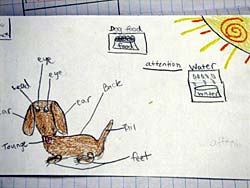
3. Vocabulary “solidifying”. It is difficult to acquire “words”. However, when we draw those words while learning, we activate a powerful part of our brain. I have students draw pictures in their notebooks beside newly acquired vocabulary. I also have them do so on worksheets, word searches etc ….. One concrete example would be a 2 way task where a student tells their partner the vocabulary to draw in “X” box. See the example below.

4. Storybook Making / Cartoons: Students make story/picture books to help them acquire language. They first draw the pictures for the story using a storyboard (very easy to make, just fold an A4 piece of paper into as many boxes as you need to detail the story). Then, the students write the story for the pictures. The teacher or peers correct and then they make a final product / book. Susan Kapuscinski is an amazing resource and teacher whose Making Storybooks, I highly recommend. Use her videos (on ehow or youtube) showing how each book is made too!

5. Doodle Songs: much like making a storybook only this time, students “tell” the song by creating pictures to contextualize the lyrics. Do a song the students like. Give students parts/lines of the song (make sure they number their picture so you can put it in order afterwards!). The students draw a picture for their line of the lyrics. We have a full player of doodle songs on EFL Classroom. See the wonderful example above, a teacher on EFL Classroom made. More in our videos!

6. Pictionary: Yes, the obvious standard. Students are given a vocabulary picture they must draw. The other students guess and the first person guessing correctly wins a point. There are many variations. Here are two online options. A) Odopod sketch slideshow. Students watch and describe/guess. They will be WOWED. B) Draw My Thing – my game of 2009. Students can play at home or it can be used as a filler in class. Just like pictionary but in real time and online. You draw with your mouse and you compete for points!

7. Online tools: If you just want a handy way to draw on the computer or big screen – Go HERE or HERE. Scribble Maps is also a great way to draw with maps. Sketcast is also a big winner!

8. Other ways! Drawing can be brought into almost any lesson plan. Too many ways to elaborate but think about how you might incorporate drawing into each of your lesson plans if possible!

Teaching Writing – Activities and Ideas

“Writing is a way of talking without being interrupted.” — Jules Renard

“ideas to get your student’s pencils moving”

DOWNLOAD THIS

Writing is and isn’t an easy thing to do in the classroom. Especially nowadays when students don’t have long attention spans and are more and more “digital” and visual learners.

However, it is a vital skill that opens up a world of possibilities for any student. Written communication in whatever language, even with the advent of the internet, is still a necessity. Writing allows communication, controlled and deliberate – POWERFUL, communication. So we have to get our students writing more and better. How?

Below, find a rundown of what I consider the “standard” writing activities for any age group. Just change the topic/theme. Most are for any classroom, EFL / ESL or the regular classroom. My belief is that writing in English is writing in English. Whether it be a second language or first makes no difference because the “eating” is all the same.

I’ve divided the activities into different categories. These are just for the sake of having some kind of organization. I’ve also labeled them

WUP – for a warm up writing activity and something to do quickly.

CP
– Controlled practice. Writing activities that help the beginning writer and offer support, repetition and guidance.

F – Free writing activities which activate student learning and allow them to practice what they already know and “test the waters” so to speak.

Where appropriate, I’ve linked to some resources that compliment the writing activity as described.

Listen — Write

1. Dictation

There are many ways to “spice” up the standard dictation. The simplest is to have the students fold a blank piece of paper “hamburger” style (Up/down) 4 times. Unfold and they have a nice 8 line piece of paper. Speak 8 sentences , repeating each several times as the students write. Get the students to record their answers on the board and correct. Collect and keep in a portfolio!

There are many online sites where students can do the same but in a computer lab or at home. Or the teacher can even try in the classroom.
http://www.listen-and-write.com/audio – for older students
http://www.learner.org/interactives/spelling/ – for young learners
- CP

2. Story Rewriting

The teacher reads a story or the class listens to an audio story. After, students make a story board (just fold a blank page so you have 8 squares) and draw pictures. Then, they write the story based on those pictures. Very simple and powerful! – F

3. Visualization

The students close their eyes and the teacher describes a scene. Play some nice background music. The students then write and describe the scene they imagined, sharing their scene afterwards with the class or a classmate.
- F

4. Pop Song Rewrite

Play a familiar pop song. One with a “catchy” chorus. Afterwards, write out the chorus on the board with some of the words missing. Students can then rewrite the chorus and sing their own version. Higher level students can simply write their own version without help. Here’s a very simple example –

He’s got the whole world in his hands

He’s got ___________ and ___________
In his hands. (3x)
He’s got the whole world in his hands

- CP

Watch —– Write

1. Commercials.

Students watch a TV Commercial. Then, they write their own script based on that commercial but focused on a different product. Afterwards, they can perform. F

2. Short videos.

Just like a story but this time students watch. Then, they can rewrite / respond / reflect. Students can choose to reflect on one standard Reading Response question or as part of a daily journal. Ex. The best part was ….. / If I had made the video, I would have ……

Short videos are powerful and if well chosen can really get students writing in a reflective manner. CP / F

How to Videos

Students can watch a short “How to” video that describes a process. There are some excellent sites with User Generated Content. Expert Village and eHow are recommended. After the students watch the video several times, they can write out the steps using transitions which the teacher lists on the board. [First, first off, To begin, then, after that, next, most importantly, finally, last but not least, to finish ] CP / F

3. Newscasts / Weather reports

Watch the daily news or weather report. Students write in groups or individually, their own version of the news for that week/day. Then perform for the class like a real news report! F

4. Travel Videos

Watch a few travel videos (there are many nice, short travel “postcard” videos online). Groups of students select a place and write up a report or a poster outlining why others should visit their city/country. Alternately, give students a postcard and have them write to another student in the classroom as if they were in that city/country. For lower leveled students, provide them with a template and they just fill in the details. Ex.

Hi……..

I’m sitting in a ………… drinking a …………… I’ve been in ……. for ………. days now. The weather has been

……………. Yesterday I visited the ………….. and I saw …………….. Today, I’m going to ………………. I highly recommend ……………….. See you when I get home …………………

Best,
………………………….
CP / F

Look —– Write

1. Pictures / Slideshows

Visuals are a powerful way to provide context and background for any writing. Make sure to use attractive, stimulating and if possible “real” photos to prompt student writing. Students can describe a scene or they can describe a series of pictures from a slideshow.

An excellent activity is to show a nice photo and get students to “guess” and write their guess in the form of the 5Ws. They answer all the 5w questions and then share their thoughts with the class.

Show a picture and get students to write a story or use it as background for a writing prompt. For example, Show a picture of a happy lottery winner. Ask students to write in their journal – If I won a million dollars I would ……
This is a much better way to “prompt” writing than simple script! – CP

2. Description

Show students a selection of fairly similar pictures. The students describe in writing one of the pictures (faces work really well). They read and the other students listen and “guess” which picture is being described. Similar to this listening activity. CP

http://eflclassroom.com/rave/Listening%20Quiz/Animals.swf

3. Bookmaking

Provide students with a series of pictures which describe a story. I often use Action Pictures. Students write about each picture, numbering each piece of writing for each picture. The teacher can guide lower level students like this Mr. X’s Amazing Day example. After editing, the students cut up the pictures and make a storybook. Gluing in the pictures, coloring, decorating and adding their own story text. Afterwards read to the whole class or share among the class. CP / F

4. Sequencing

Provide students with a sequence of pictures which are scrambled. The students must order the pictures and then write out the process. Ex. Making scrambled eggs. F

Read —- Write

1. Reading Journal / Reading Response

The students read a story and then respond by making a reflective journal entry. Alternatively, the students can respond to a reading response question like, “Which character did you like best? Why?” F

2. Rewrite

Read a short story and then give students a copy of the story with some text missing. The students can fill it in with the correct version OR fill it in and make the story their own.

Rebus Stories

These are stories where words are replaced with icons/pictures. Students can read the story and then write out the whole story, replacing the pictures with the correct text. Here are some nice examples. – CP

http://abcteach.com/directory/basics/rebus/

3. Opinion / Essay

Select an article or OP Ed piece that students would find interesting or controversial. After reading and discussing, students can respond with a formal essay or piece of writing reflecting their opinion. Read them anonymously afterwards and get the class to guess who wrote it! F

4. Giving Advice

Students read a problem provided by the teacher (even better, get students to provide the problem by having them write down what they need advice on). This can often be an Ann Landers style request for advice from a newspaper. Students write their own response, giving advice. F

5. Running dictation

This is a lot of fun but quite noisy. Put students into groups of 3 or 4. For each group, post on the wall around the classroom, a piece of writing (maybe a selection of text you will be reading in your lesson). One student is appointed as the secretary. The other students must “run” to where their piece of writing is on the wall and read it. Then run back and dictate it to the secretary who records it. Continue until one group is finished (but check that they got it right!). CP

Think —- Write

1. Graphic Organizers
These you can make on your own by having students draw and fold blank sheets of paper or by giving them a pre-designed one. Students write out their thoughts on a topic using the organizer. An alphabet organizer is also an excellent activity in writing for lower level students. Graphic organizers and mind maps are an excellent way “first step” to a longer writing piece and are an important pre-writing activity. WUP

2. Prompts / Sentence Starters

Students are prompted to finish sentences that are half started. They can write X number of sentences using the sentence starter. Many starters can be found online. Prompts are also an excellent way to get students thinking and writing. Every day, students can “free write” a passage using the daily prompt (ex. What I did this morning etc… ) Creative writing of this sort really motivates students to write. There are many lists online you can use.
- WUP

3. Thinking Games

Using a worksheet, students play the game while writing down their responses in grammatical sentences. What the Wordle / Not Like the Other and Top 5 are some games I’ve made and which help students begin to write. Each has a worksheet which students fill out. CP

4. Decoding / Translating

Translating a passage into English can be a good writing activity for higher level students.

Students love their cell phones and Transl8it.com is a handy way to get students interested in writing. Simply put in English text and Transl8it.com will output “text messaging”. Give this to students to decode into standard English and then check against the original. Lots of fun! See the games I’ve designed (Pop Song / Dialogues ) using this principle of decoding text messaging. CP

5. Forms / Applications

Students need to practice writing that will be of use to them directly in the wider world. Forms and filling in applications are a valuable way to do this. Fill in one together as a class and then get students to do this same for themselves individually. – CP

6. Journals / Reflection / Diaries

This type of free writing activity should be done on a regular basis if used in class. Use a timer and for X minutes, students can write upon a topic that is important to them, that day. Alternatively, students can write at the end of the day and record their thoughts about the lesson or their own learning. These are all excellent ways for the teacher to get to know their students. One caution – don’t correct student writing here! Comment positively on the student’s writing – the goal is to get them feeling good about writing and “into” it. – F

7. Tag Stories / Writing

Students love this creative exercise. Fold a blank piece of paper vertically (Hamburger style) 4 times. You’ll have 8 lines. On the first line, students all write the same sentence starter. Ex. A man walked into a bank and ……..
Next, students finish the sentence and then pass their paper to the student on their left/right. That student reads the sentence and continues the story on the next line. Continue until all 8 lines are completed. Read the stories as a class – many will be hilarious! I often do this with a “gossip” variation. I write some gossip “chunks” on the board like; “I heard that..” , “I was told…” “The word on the street is…” “Don’t pass it around but…”. Students choose one and write some juicy gossip about the student to their right. They then pass their paper to the left with everyone adding onto the gossip. Students really get into this! CP / F

8. Describe and guess

Students think of a person / a place or a thing. They write a description of them / it and they are read out and others students guess.

Jokes and riddles are also effective for this. Students write out a joke or riddle they know and then they are read and other students try to guess the punchline. – F

TEXT —– Write

1. Sentence Chains

The teacher writes a word on the board and then students shout out words that follow using the last letter(s). The more last letters they use, the more points they get. The teacher keeps writing as quick as possible as the students offer up more correct words. Ex. Smilengthosentencementality…..
Give students a blank piece of paper and in pairs with one student being the secretary, they play! This is a great game for simple spelling practice and also to get students noticing language and how words end/begin. They can also play for points. Compound words and phrases are acceptable! – WUP

2. Guided Writing

This is a mainstay of the writing teacher’s toolkit. Students are either given a “bank” of words or can write/guess on their own. They fill in the missing words of a text to complete the text. Take up together and let students read their variations. A nice adaptation to guided writing for lower level students is for them to personalize the writing by getting them to draw a picture for the writing passage to illustrate and fortify the meaning. Here’s a nice example. CP

3. Timelines

Use a time line to describe any event. Brainstorm as a class. Then students use the key words written on the board, to write out the time line as a narrative. Really effective and you can teach history like this too! Biographies of individuals or even the students themselves are a powerful writing activity and timelines are a great way to get them started. – F

4. Notes

Students are given notes (the classic example is a shopping list but it might be a list of zoo animals / household items etc…) and then asked to write something using all the noted words. This usually focuses on sequence (transitions) or location (prepositions). F

5. Grammar Poems

Grammar poems are short poems about a topic that students complete using various grammar prompts. This form of guided writing is very effective and helps students notice various syntactical elements of the language.

Put the grammar poem on the board with blanks. Here are some examples but it could be on any topic (country, famous person, my home, this school, etc..). Fill out as a class with one student filling it in. Then, students copy the poem and complete with their own ideas. Change as needed to stress different grammatical elements. And of course, afterwards SHARE. Present some to the class and display on a bulletin board. Your students will be proud of them!

SPEAK — Write

1. Surveys / Reports

Students have a survey question or a questionnaire. They walk around the class recording information. After, instead of reporting to the class orally, they can write up the report about their findings.

This can also be used with FSW (Find Someone Who) games. Students use a picture bingo card to walk around the classroom and ask students yes/no questions. They write the answers with a check or X and the student’s name in the box with the picture. After, they write up a report about which student ……. / didn’t …… certain things. CP

2. Reported Speech

Do any speaking activity or set of conversation questions. Afterwards, students report back by writing using reported speech, “ Susan told me that she ………..” and “ Brad said that ………..” etc….. CP

3. Introducing each other

Students can interview another classmate using a series of questions / key words given by the teacher. After the interview of each other is over, students can write out a biography of their partner and others can read them in a class booklet. – F

4. In class letter writing

Writing for a purpose is so important and nothing makes this happen better than in class letter writing. Appoint a postman and have each student make a post office box (it could just be a small bag hanging from their desk). The students can write each other (best to assign certain students first) and then respond to their letter. Once it gets started, it just keeps going and going… – F

4. Email / messaging / chat / social networking

This is an excellent way to get students speaking by writing. Set up a social networking system or a messaging / emailing system for the students. They can communicate and chat there using an “English only” policy. Use videos / pictures like in class – to promote student discussion and communication. Projects online foster this kind of written communication and using an CMS (Content Management System) like moodle or atutor or ning can really help students write more. – F

5. Class / School English newspaper or magazine

Students can gain valuable skills by meeting and designing a school English newsletter. Give each student a role (photographer, gossip / news / sports / editor in chief / copy editor etc…) and see what they can do. You’ll be surprised! – F

WRITE —— Do

1. Dialogues

Students can write dialogues for many every day situations and then act them out for the class. The teacher can model the language on the board and then erase words so students can complete by themselves and in their own words. Here’s a neat example using a commercial as a dialogue. – CP

2. Drawing

Students draw a picture and then write a description of the picture. They hand their description to another student who must read it and then draw the picture as they see it. Finally, both students compare pictures! – F

3. Tableaus / Drama

Students write texts of any sort. Then the texts are read and other students must make a tableau of the description or act out the text in some manner. For example – students can write about their weekend. After writing, the student reads their text and other students act it out or perform a tableau. F

4. Don’t speak / Write!

I once experimented with a class that wouldn’t speak much by putting a gag on myself and only writing out my instructions. It worked and this technique could be used in a writing class. Students can’t speak and are “gagged”. Give them post it notes by which to communicate with others. Instruct using the board. There are many creative ways to use this technique! – F


RECOMMENDED BOOKS 4 TEACHERS

I highly recommend the following two books for ideas and some general theory on how to teach writing. Purchase them for reference.

1. HOW TO TEACH WRITING – Jeremy Harmer
Very insightful and cleanly, simply written. The author explores through example and description, all the facets and theory behind that “looking glass” which we call teaching. I use this as a course text for my methodology class for in-service teachers.


2. Oxford Basics: Simple Writing Activites
- Jill and Charles Hadfield
This book (and series) is a gem! Jill Hadfield knows what working EFL / ESL teachers need and in this book there are 30 simple writing activities which teachers can use with a wide variety of levels and with only a chalkboard and a piece of chalk / paper.
_________________________________________________________________________

See my Blog post and download the list of my TOP 10 WRITING WEBSITES FOR TEACHERS AND STUDENTS

Getting your students “speaking” – Some Strategies.

conversation1It isn’t easy to get students speaking sometimes. But it is well worth it! It is truly the road towards a fluent, confident speaker of English.

I remember when first confronted with a “silent” class. They were really passive and not willing to speak. After lots of trial and error I finally came into class gagged! (yes, I was brash and bold in those days!). I continued with the lesson as normal but there wasn’t any speech from me. Soon enough, the students couldn’t stand it and they started speaking! Not terribly lots but a beginning. And more than anything, I broke the crust and now it was all creme de la creme…….

With the coming of the Communicative Language teaching approach, instruction began to focus less on grammatical form and more on meaning. Part of this new emphasis on meaning meant that instruction would have to emphasize “communication”- 2 or more people negotiating and exchanging meaning.

Oral Interpersonal Communication was pushed into the spotlight. Students were expected to use functional, situational, everyday language in class. The mantra was to decrease “teacher talk” time and increase the production time of students (Swain’s concept of Comprehensible Output informing this approach). Student talk meant the following;

1. Authentic, unscripted, not memorized activities. Ex. Task based role play.

2. Meaning based. Transfer of information was the goal. Ex. Information gap

3. Listening and interpretation of the speaker is necessary.Communication became a two way street of listening and speaking.

4. Meaning was negotiated. Repetition, clarification, confirmation, pausing, signaling of not understanding, interjections, pragmatics (gestures) were all to be practiced as part of natural conversation.

Research has shown that students who experienced more time producing meaningful language, gained higher levels of fluency. Yet, teachers understanding the above, still had to get their students talking. How?

Here are some tips outlining many of the standard approaches to fostering oral interpersonal communication (a big word for speaking) in the English language classroom.

A. Set the correct tone.

The affective filter that Krashen alluded to, and the fear many students have, must be lowered by making students comfortable and the teacher providing a “safe” environment. Students won’t speak unless they feel comfortable. Teacher modeling of all activity and showing a very self-depreciating manner really helps. Clapping and rewarding mistakes also helps set the right tone. First bring the class together as a team, then focus on communicative language teaching. Don’t put the cart before the horse.

B. Assist performance.

The teacher acts as a facilitator or discussion leader. The teacher activates background knowledge on the topic or theme and uses
language that scaffolds learning of the L2. The teacher in an Instructional Conversation (IC) approach offers feedback to the students in the form of correct usage and providing language model forms. The teacher focuses on the object of the learning and assists students in practicing that. The teacher arranges tasks in sequence so that students can perform them with increasing ability.

C. Turn taking.

The teacher explicitly teaches students how to take turns in a conversation. Communication is a two way street and the teacher should after each answer by a student, prompt them to continue the communication with a question or suggestion.

D. Use tasks and especially 2 way tasks.

Students can be motivated to speak, “if there is a need”. A two way task where there is some information missing, provides this kind of motivational need. See the attached examples of an info. gap kind of activity which really acts as a catalyst towards inflaming student talk time.   HERE ARE SOME EXAMPLES

E. Use authentic texts and topics/themes that the students are interested in.

Nobody enjoys talking about something that doesn’t interest them! Make it real and make it up to date with timely texts (news items, celebrity gossip, hot topics etc…) Keep it about their lives and world. In order to generate speech, the students need “some fuel in the tank”, something they know a lot about. Keep them driving (speaking) on a full and powerful engine!

F) Tolerate silences.

Yep, sometimes that is necessary. So often, students aren’t speaking simply because the teacher seems so good at it! Wait more often and the students will respond. One of the things experienced teachers do better is that they wait longer after questions. This gives the student more time to work out the language in their head, more time to articulate themselves. It isn’t easy speaking in an L2 – slow down!

G) Get them on their feet!

Have you ever wondered why we teach students while they are sitting down when 80% of human language is produced while standing up? Get them practicing what they will be preaching! Simply giving them a slip of paper with one question or prompt and having them walk around the class exchanging it and finding others – does wonders for acquiring language and practicing what I call – authentic production.

H) Modify other teacher behaviors.

Listen more to your students. Really listen with an interest and exaggerate so they know you are! Pause often, altering your rate of speech while maintaining naturalness. REALLY speak to your students, about real topics and concerns. Keep it real. Do what you ask your students to do. Be one of them when possible and do the same tasks. Also, learn to step back, step aside. If the class is really speaking English and using English – roll with it!

I) Give students the ammunition to succeed
.

Provide gambits and target language forms on the board to help lower level students succeed. Preteach essential vocabulary and make sure your students are ready to handle the task (for the most part). Provide pictures as prompts and modify the activity for lower level students.

J) Teach inductively!

Too often, us teachers follow the basic lesson plan. Engage or Prepare / Study or Practice / Activate or Present . However, what often happens in class is that the most important stage – Production, never happens! The bell rings and the students get little time on their feet speaking. So turn your lesson plan upside down! Start with the production activity. Then do some controlled practice if necessary, so they can see how the correct production should have been.

K) Enjoy yourself.

Yes, we’ve come full circle. If a teacher shows they are enjoying themselves, the students will too. This will only foster the proper classroom environment for oral production. Hopefully, you’ll be so luck as to have a classroom of Argentinians I had years ago – they just wouldn’t shut up! I would get major headaches but happily so…….

This teaching with Bailey episode focuses on the problem of “silent students” and how to engage them so they will “open up”. A neat look, as Bayley always is!  Go here for more videos with Bayley


Find more videos like this on EFL CLASSROOM 2.0