5 Myths About Learning

I spent part of the morning rereading Frank Smith, particularly his thoughts about how we learn. Delightful, insightful, thoughtful.  Here’s an excerpt from his book: Comprehension and Learning but I also highly recommend his book about whole language, Understanding Reading.

One of the things that I think hinders many teachers and stops educational reform is our misguided beliefs about learning. Our beliefs about learning are part of framework that govern our behaviors as a teacher (Stern, 1983; beliefs about language, society, learning, teaching).  If our beliefs are more inline with “how things were done to me” and not research driven – we end up with an educational model that is dysfunctional.

Through my years of teaching, I’ve come to see 5 large scale myths about learning which operate across our teaching culture.  They don’t allow for effective teaching or learning.  I used to adhere to all of them but have worked hard to brush them away from in front of my eyes.   Here they are for your reading and assessment.

1.  Learning is orderly.

Learning isn’t a tidy, stage 1, stage 2, clean, unidirectional affair.  It is individual and we each form and make our own connections to get from A to Z.  Further, there is no way we can measure or be sure of “what” the student will learn. We may be teaching about past participles but the student could be learning how the letter P is written on the board (while viewing us write it several times).  Most of learning is accidental and incidental.

Smith says that the core of learning is through “demonstrations”.  The world is full of demonstrations and in a class or a book/activity – the demonstrations are not just the ones we wish the student to learn.  Each act is a cluster of demonstrations and we can never be sure which the student will learn or consume.  I’ve always been astounded that the research shows that the best way to teach a student to read and love reading is to just have students see you the teacher reading and enjoying text/books. With this demonstration, they are learning just as much as they would by or through a read aloud.

Learning is not orderly, it zigs and zags and as teachers we should believe in the long term goal/destination and not be occupied/frustrated at keeping students on a straight line of learning.

2. Learning is a fight, a struggle. 

Yes, that’s what we are all taught – we have to “wrestle” with ideas and struggle to understand.  However, exactly the opposite is the case – struggle and effort do not happen when there is learning and are actually evidence of the opposite (part of the boredom spectrum with one end being quiet “giving up” and the other end, fierce effort). Learning is not something effortful. When a student is learning, there is engagement, thought, flow, rhythm – the student is within the learning zone and is motivated by each successive success not their failure.

Most teachers teach failure, not success. Most teachers teach students to reach to far ahead instead of that knowledge which is within reach. We teach too fast and too violently for most students.  We leave a train wreck of students who can’t learn, don’t even want to learn,  in our wake.

Learning is what happens when there is an absence of the expectation that it will not take place.

3.  Learning is either on or off. 

So many of us teachers believe that if Johnny is looking out the window, he’s “not learning” and just goofing off.  What we really should be honest about is that he is just not learning what we are teaching or want him to learn.

Learning is something that is a natural part of our cognitive and biological make up. It is never “off”.  We are all constantly learning and are incredible learning machines. This in fact might be our most important human trait – man the learner (and by default, flipping it, man the teacher).

Learning is something active and organic, always on. As a teacher, be aware that a light is always on in our students. We ignore this at our peril.

4. Learning = knowing.  

Learning is mistakenly equated with knowledge.  That we know something means we have learned it.  How mistaken we are!  Knowing is only the start of learning, the surface and appearance of learning. Knowledge is an empty vessel.

As teachers, we need to understand that a student learns something only when they understand and can apply it in a new situation. Our life teaches us what we have learned.  Now you may say to yourself that most teachers know this, it isn’t a myth.  And you’d be absolutely right – teachers do “know” this but have they learned this?

5.  Learning is a solitary act. 

At the end of the day, most teachers believe learning is done alone, in our own heads. It is the grey matter and how it flickers and sparks that counts. That is why we test individuals and put up big dividers between students in test areas.  We want to know what that student learned.

However, we err.  What a student knows and learns is always something that can’t be ripped from the social fabric.  Students learn because they make an investment in “the other”.  This could be an imaginary Harry Potter, their science project peers or a favorite teacher but learning is dependent on the existence of “the other”.  Students learn when they are interested in something someone else is doing – there is no getting around this.  Students also learn as a social unit and should be tested as such, despite our Cartesian and individualist cultural mindsets telling us not to.


Strange stories about language learning

Over the years, I’ve kept my eyes and ears open for great “thought experiments” for language. Real examples and events that are so extreme, they really force you to think differently about ones preconceived notions about language learning (and by default teaching it).

Here are the top 5 examples off the top of my head that are indeed “out there” and from the Twilight Zone.  Please tell / share your own!

1.  Daniel Tammet learns to speak fluent Icelandic in one week.

A famous idiot savant, Daniel took on the challenge and bet of learning Icelandic in one week.  He succeeded, going onto national Icelandic television and passing as a fluent speaker.  He even went on to found his own language elearning company Optimnem.

2.  1930, the Leahy Brothers visit the highlands of New Guinea.

First Contact, an amazing film about the first meeting of the tribes in New Guinea and white men.  Fascinating how decades later, the film makers return and everyone laughs about the first contact and shares stories in the now common pidgeon/creole.

3.  Wade Davis writes in The Wayfinders about linguistic exogamy.

A remarkable book where the explorer and thinker writes about cultural diversity, the “ethnosphere” and language death and its consequences. He reports about a fascinating Amazonian tribe, the Barasana, that has a rule whereby you must marry outside your language group. Some extended families have 7 or 8 languages with everyone speaking them all!


4. North Korean man doesn’t speak or hear German for 47 years but after a few days can speak German fluently again.

The true but fascinating case of a N.Korean man who left his German wife and 2 kids in E. Germany in the 1960s.  47 years later, she and her kids reunite in N. Korea and he remembers all his German, no problem!

5.   The Imposter documentary.  How identity is stronger than language.

Amazing documentary and must see. About a young adult in Spain who fakes a story to assume the identity of a boy who disappeared years before in Texas. The family accepts that he is their son despite his heavy accent!


6. Lastly (but not actually true), the Twilight Zone episode “Word Play“.

A man starts his normal day but as the day goes along, all the language changes. Dinosaur becomes “lunch”. Dog becomes “Wednesday”. Asks us to reconsider what is a word and remember it is all arbitrary!

Joking Matters

I’ve spent the weekend reading the Heidegger and a Hippo walk through those Pearly Gates, the sequel to the amazing Plato and a Platypus Walk Into A Bar. Amazing books that combine commentary with jokes.

As I’m reading, I was thinking of how jokes so well inform us teachers. So many times, jokes have framed so well, important questions that I’ve needed to ask myself so that I could be a better teach. Koestler in his Act of Creation defines jokes and especially puns as the “epitome of intelligence” and when the world that is the mind opens up and understanding results. We learn from a joke so well because it kind of short circuits our brain through two clashing ideas. Out of those two opposites is created something new – our understanding.

So today, I’m asking fellow teachers to tell a joke that really says something to them about either language, teaching or learning. A few words in explanation of the joke welcomed. Here’s my own offering from today’s reading.

Three elderly men visit a doctor for a memory test. The doctor asks the first man, “What’s 3 x 3?”
The man says, “285!”
Worried, the doctor asks the next man, “What’s 3 x 3?”
The next says, “Uh, Monday?”
Even more concerned, the doctor motions to the third man. “Well, what do you say? What’s 3 x 3?”
“Nine!” the third man replies.
“Excellent”, the doctor exclaims. “Tell me, how did you get that answer?”
“Oh that was easy” the man says, “I just subtracted 285 from Monday”.

What this speaks to me:

Language is so so so personal. We all have our internal logic and how we order it and arrive at its “meaning” and structure. We call this an interlanguage in second language learning. A language all our own, our own way of organizing the “sound and fury”.  Teachers have to consider this and also consider the other side of this – just maybe the student had a lucky guess!  We have to sometimes look beyond the answer and at something more important, how students arrived at the answer and higher up Bloom’s into process and analysis.

Further, this jokes speaks to the fact that students needn’t know how they know what they know. Language is acquired very unconsciously and the student may indeed be perfectly competent in retelling a story using the simple past but be totally unable to explain how they formed the right  /ed/ endings.

One last joke to share but no explanation given – I’ll let you tell us what it might mean. 

A man and woman enroll in a Chinese language course.

Their instructor begins the first lesson by asking them , “Are you planning on traveling to China?”

They explain, “No, we just adopted a baby Chinese girl. When she gets older and begins speaking, we want to be able to understand what she is saying.”

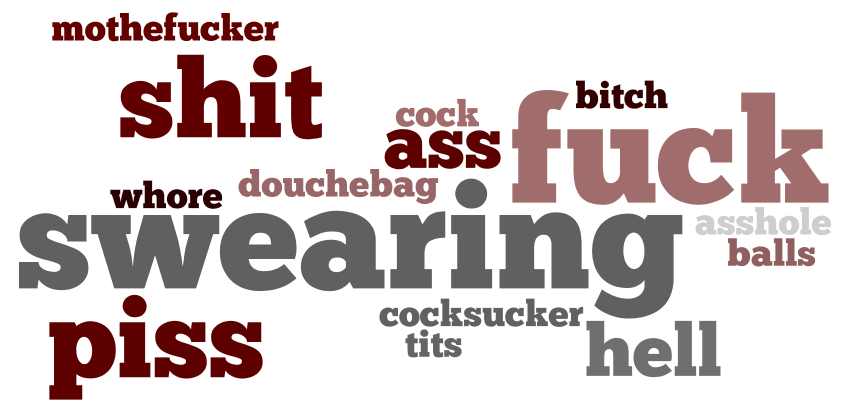
Learning To Swear

“I am my language.” What a powerful phrase about how language is so wrapped up with identity. Both our own personal identity and our social identity in a larger group.

A language learner aims to get to the moment where they “flow” with the language and “sing” language (Anna Deaver Smith talks about this here). It is the ultimate goal for all second language learners – a moment where they become one with the second language and take on a whole new identity. I remember learning French for many years yet never really identifying with the language, it was kind of something added on to myself. A bag I picked up and used when appropriate. Then, after a few months in France and hanging out with a lot of Corsican friends, I started swearing in French. Just naturally, may I say, beautifully. It was at that moment I became “French” and assumed my French identity.

This begs the question – is learning to swear a way for a student to identify and associate with their second language? For them to get motivated and feel at home in the “second language skin”? Should teachers teach swearing, how to swear?

I’ve written about this previously and at length. But today, I got to thinking about how you might teach swearing or even if you can. Swearing seems much more than the sum of its parts. We usually acquire swearing rather than learn it. We hang out with a social group that swears and we naturally pick it up. We all remember how our parents were concerned about our English getting “bad” if we hung out with the wrong types. I worked as a steel erector a number of years after university and my own family just couldn’t believe the mouth on me!

It would be difficult for any teacher to teach swearing I think. Students would love it but I can see administration, parents etc…. being up in arms. Also, it would depend on the teacher having a certain comfort level with swearing – we have a natural aversion to it unless anger/emotion overcomes it. You also never see it in a coursebook. It is a vital part of the English language but we just assume students will learn it themselves as if by magic. I say, if you can, teach it, use it in class – it will empower your students. But it is for you the teacher to be the judge.

This commercial is a nice way to begin. Here’s a worksheet for it. It also raises the issue of English only workplaces and how the language would exclude many second language speakers (this paper is a great review of this topic). A great read on the topic of swear words is George Carlin’s Seven dirty words. (and video).

But the question remains – would you ever use this in class?

Accent Agape

I spent a large part of a wonderful day stuck in the car. Thankful, saved by a wonderful interview with Slavoj Zizek, philosopher and iconic social critic. Catch the same interview here.

What I love about him besides him irreverence (laughed like crazy when he said that 50% of the movies he’s written essays about and reviewed, he never watched!) has to be his accent. Love it! As a language lover, I love accents, embrace accents and salute accents. Not a common thing in my field where millions are spent promoting farcical “accent reduction” programs.

An accent is something we need our students to love. We should be their coach in getting them to fall in love with the way they speak a foreign language. If they think they sound sexy, they’ll certainly feel so much better about the language learning experience, be more motivated and have a brain fully loaded with dopamine and endorphines. We should compliment our students continually and encourage their love of their own voice. It will pay off lots. Play Zizek for your students and ask what they think about his accent – as a way to start this conversation.

Most will say his accent is too strong, too “je ne sais pas quoi”, too, too, too….. I find it wonderful and also great that we do take the effort, are forced to take the effort to understand him. That’s what makes language lovely, this diversity, this huzzah of sound. Stephen Fry in a well known speech decries also, our reluctance to appreciate speech, the sound of speech, the dance of words, the spray of meaning …. We love music but very seldom do we honor a speaker and his “sound”. Zizek, I honor you and want you to be a model to all my second language students.

But language is a funny beast – it is governed by the paradox of anamorphosis, here Zizek outlines it while discussing a different issue, the movie, Children Of Men.

“the paradox of anamorphosis: if you look at the thing too directly, (the oppressive social dimension), you don’t see it. You can see it in an oblique way only if it remains in the background” (Žižek 2006a: unpaginated)

I’ll leave you with that quizzical thought – you take it from there and think what I mean. I know Zizek would understand!

Free “Won’t”

I’ve been thinking a lot about “free will” and the nature of the choices we make – both in teaching and in life.

Recent research, especially since the famous Libert experiment, suggests we make decisions before we even know we make decisions. Meaning, something, a “ghost inside the machine” is controlling us and that free will according to most neuroscientists, is an illusion.

Big claims. Big ideas. And what does this have to do with teaching?

Teaching is very transactional in nature. We make thousands of decisions during the teaching day. This is the “art” of teaching. Some studies suggest we make on average over 3,000 decisions / day – that’s around 7 or so a minute. Up there with stressful jobs like air traffic controllers and athletes on the field. Teachers are “decision beasts”. But what does this research saying to us, your decisions don’t matter, they are all preordained, what does this research mean to a teacher or student?

I think it points to the fact that freedom, free will, is by nature, “negative”. We humans make decisions based on “no” and not “yes”. Oscar Wilde’s famous dictum that, “The true freedom of man rests in the capacity to say no”, rings true.

I remember reading Isiah Berlin, a very underrated philosopher who pointed towards this same kind of negative freedom of will as being primary. (his “The Power of Ideas” is well worth reading). Our freedom is realized through interventions – that we “not” do certain things. This fits well into what a teacher does. They don’t so much make choices as negate certain choices from occurring. They break into the normal routine and outrolling of human social behavior and push it in new directions. Teachers don’t control the water in the river, they can’t decrease this water’s flow. However, they can throw things into the river and effect its direction, speed, course…..

I see the same sort of thing happening in the language student. The student takes in so much input but won’t make progress unless this input is “negated”, unless the student says, “No” to this language form/item. This partners well with the notion that language awareness, “noticing”, is so powerful and not until then, does a student learn from language input. You can spend years in a room listening to seemingly meaningless sounds and babble. But once you have a piece of the puzzle, some foothold of meaning, you can say “No” to the flow of language and begin to direct its course and find the true “flow” and “path” that is fluency.  This is why I’m a big believer in the power of instant feedback through invasive technology – something EnglishCentral does well. Giving the learner an instant comparison of their language pronunciation and form against a model. Based on this, they can express their “Free Won’t” – saying in effect, “I won’t make that mistake again!”.  Noticing.

If this all seems abstract and rambling, it is! I’m jet lagged and using my blog as a sounding board and reflective source of knowing. In any case, it is something to think about – that learning is not saying “yes” to information but rather the ability to discriminate discrete units of information and realize our freedom through the fundamental power of “Free Won’t”.

If you liked this post, you may enjoy “The four keys to language learning: Input, Input, Input, Noticing.”

The Idiot’s Dictionary – early release

aI mentioned this book previously. Now, releasing it early – I’ll have a hard cover, POD (Print On Demand), for purchase version shortly.

Download The Idiot’s Dictionary.doc

I’ll only say thank you to my niece Gabriella, who painstakingly went over the copy and edited everything. Thank you! Here, I’ve reprinted the short forward (the print book will contain a much longer and well researched essay on the topic of “the dictionary”).

Enjoy and comments, your fav. definitions, welcomed!

—————-

About this book

This book was written over 20 years ago, over a few days. A result of my own “Foerster’s Syndrome”, a kind of lexical illness which I suffer gladly. Both an incessant need to pun and an uncontrollable reflex of seeing meaning within words. A kind of inability to see the forest (word) for the trees (the sounds / meanings).

But I’ve lived with it and learned to control it. Still, ever so often, this Jabberwooky, this moloch and primordial beast attacks and I’m back in the land of the idiot’s dictionary ……

I’ve written a lot about the power of words over the years. See my previous book – “The Unbearable Lightness of Being a Teacher” for those. I’ve studied and been influenced by all the creative writers / poets who’ve pushed the frame of reference in which language lives. Valery, Mallarme, Stein, Breton, Borges, Gass, Calvino, e.e. cummings to name just a very, very few. The Gagaism manifesto, born of the same time as the dictionary (at the end of this book) – stands as my own theory of language in the world.

I also must emphasize my own use of the word “dictionary”. This book is my belief that “We, the people” should have control of the language – not the Websters and Murdochs of the world. A dictionary is not a definitive source but rather, an interpretation. This book, my small attempt to put a dent in the prescriptive armor we wear as we walk the world, in the flesh born of “the word”.

————————————–

I’ll end with this wonderful passionate appeal of McKean for a new kind of dictionary, a new participatory and living dictionary of meaning and metaphor.

Memory and Language – an experiment.

BRAIN_2I’ve always been fascinated by the role memory plays in language acquisition. It isn’t a straight forward relationship (better memory = better fluency) however, looking at student “2nd language memory” does allow us teachers in a very crude way, to gather knowledge about student fluency.

There is a lot of research on the subject, no better place to start than the Journal of Memory and Language. Highly technical and it’ll cost unless you are employed by a university with access. However, lots there.  I’ve collected some bookmarks that have some general articles on this topic and cognitive linguistics.

For the lay teacher like you and me, the issues revolve around working and stored memory. Also issues to do with the right and left hemisphere (where language is contentiously said to “reside”)  and brain plasticity in general.

But this isn’t my reason for posting (other than to jostle some curiousity). I’m posting because I have a request. I’d like some teachers to try out the following experiment and then report back. The experiment is based on my own observation that student fluency is directly related to short term memory recall of language items.

Background

When I first began teaching I was given leveled classes and a busy schedule. Evening classes. Inevitably, the school owner would come to me between class breaks and just before classes, asking me to “test” a student, so we could put them into the correct level of class. I was always rushed and didn’t have  a lot of time to spend with them. I had to get a system for quickly discerning their level but which wasn’t so subjective and cursory. What to do?

I started having them do the normal quick placement paper test. In addition, I talked to them for 5 min.  Socially and then using a photo, asking progressively more difficult questions. Once they began making mistakes in both form and function/meaning – I’d knew which level they’d be put in. This still took a long time! I just couldn’t do all that, every day and still prepare for classes and have some downtime to recuperate between classes. What to do now?

The Experiment

So this is what I did and it worked. I’d like you to repeat the experiment and give it more validity (or destroy its validity!). It would also make a great MA thesis, if anyone needs one! Give the student who needs to be leveled a short story, one paragraph long. Here’s a sample.

John is 21 and studies math at university. He lives with 3 other students in a 2 bedroom apartment on the 5 th floor of an apartment building, outside of the city.  Every Friday he does the shopping. He buys a lot of pasta and rice. He also likes meat pies and potato chips.  His budget is usually $45 per week. Sometimes, he buys ice cream. He never buys candy.  He walks to the grocery store which is about 6 blocks from his home, near a park. If it is raining he takes the 618 bus which takes about 5 minutes.

Let the student read it for only 1 min (or you read it to the student).  After the student has read the passage, ask them some  recall questions. {What is his name? What day does he go shopping? How much does he spend? What does he never buy? How many students does he live with? etc…}

The hypothesis to be tested is:    Is the amount of immediate information recalled (remembered)  by the student related to their language level? If so, how close is this relationship?

My contention and informal findings are that memory is related to language fluency level.  All students understand everything in the passage for the most part – however, only higher level students are able to store the information (because they aren’t focusing on form so much – this is related to Van Patten’s input processing hypothesis (1992), that meaning and form cannot be attended to at the same time by second language students). This test/experiment  might be a very objective and quick way to give a placement test. Much more accurate I believe than the present day tests which are very elaborate and thus, due to this complexity, allow students to “trick” the test and cause problems in validity.

What do you think about my experiment and the relationship between working memory and language fluency level?


Language_overview

Learning a language

This video is raw, raw and real. Meaning, to me it speaks on many levels (both good and bad) because it is from the heart, the belly and the brain – because it has spirit and eyes and emotion. We need more of this type of thing for our students, even given by our students.

I just wish it wasn’t about $$ but about language learning (or teaching). You gotta want it. You gotta eat, sleep and breathe it. You gotta see nothing but it. Then, you’ll get there and you’ll uv done it. And if you fall, fall looking up. ‘Cause if you can look up, you can get up. Fall and then get up and try again, and again, and again. ‘Til the roosters come home to rest.

It’s so strange how the ends, the extremes are both so close, so similar. How this message and this great SERVE message – both opposites, say the same thing. To me anyway.

Snippets:

Don’t cry because you quit. Cry to keep going.

You won’t be successful until you don’t need a dime, a return, a nothing, to keep going.

All men are created equal but some worked harder pre-season.

It’s not about where you come from, it’s about heart.

To be able at any moment to sacrifice what you are, for what you want to be.

Word.

Do you hear me? Do you hear this guy? How’s this for a keynote at an educational conference!

Stickiness – What makes what you do stick?

stickinessI’m putting together an online presentation for some Brazilian teachers and I’ll be talking about “Stickiness”. I thought it would be worthwhile to air my own thoughts specifically about what makes our teaching “stick”. In other words, how to make what we do transfer into the heads and the production/fluency of the learner (now or over time).

I think at bottom, this metaphor is what drives most teachers. It drives a lot of schools and administrators that’s for sure. Progress, success, results….. I also think it is something students desperately want. However, the pickle is that both time and the differing needs of students make it very hard to make things sticky for everyone of your students.

Here though, are my top 5 things teachers can do to make language stick (and let’s be clear, sometimes you can do all these and still fail through no fault of your own).

1. A Warm, Comforting, Social Environment

Krashen’s concept of an “affective filter” gave this a name but teachers at all times and places have always been aware about how important it is to “relax” students. Anxiety, tension really does inhibit unconscious acquisition of language – the best way to learn English long term. A great teacher can relate personally to his/her students, relax them and make them willing to take risks. Risk taking is the most important characteristic we should promote and form in students – research supports this. The only way to do this is to create a safe, nurturing environment.

2. Local and Culturally relevant content

Context is queen with language teaching (content – the words/language are still king).  You can’t teach a student what a rutabaga is unless you can provide context, words won’t suffice. The BEST context is the student’s own world and neighborhood – their life. Use local maps, celebrities, songs and issues. It works! Here’s a talk where I expound on CST (Culturally Specific Content) for the Korean context.

3. Consistent Monitoring and Feedback of Student Achievement

Motivation is the pink elephant in any classroom. We have to deal with it and one way is to give students lots of success and especially feedback. They need to be monitored and self monitor their learning through structured feedback and testing. No, I’m not advocating those big standard tests – rather more authentic assessments (quizzes, reflection, repetition, journals, projects).  We have to realize that small but consistent feedback in the way of quizzes, really motivates but also helps students learn language. See this NYTs article for an interesting take on this.
4. Purpose: Linking class activity to real goals and actions

The classroom is a test tube of sorts. It is where we test our language. But it is only half of what makes a fluent speaker. The real test is the real world. Nowadays, it is much easier for teachers to link the trials of the classroom to the big test of the real world.  Multi-media, web 2.0 tools, bringing in people from the community, projects etc… – any way to make what the students do in the classroom “meaningful” and “real” is crucial. Students will get motivated and learn better if they know what they are doing is more than just “killing time” or “getting a mark”. Language is a skill, let our students know it isn’t just a video car game and put them in the real car!

5. Differentiation and flexibility through an enacted curriculum

When I teach curriculum development courses – I drill into my students the importance of having an “enacted curriculum”. Not one set in stone as the textbook pretends. One with a plan but a plan that you can alter and shift. It has to be so. If your students don’t know many basic verbs – you can’t march on through a unit on modals! But teachers do, believe me, they do…..  Let’s be honest and try to make the classroom an organic place where the teacher is contantly assessing student’s needs and adjusting for their levels and differing learning styles. One size won’t fit all.  These issues are in part why I’m such a big fan of SDL, self directed learning.

________________________________

One additional thing I would mention is the need to focus on “verbs”. Verbs are the fly paper of language. Get your students mastering many verbs and all the other functional and concrete vocabulary will “stick”.

I’m sure you have your own thoughts – please leave a comment and tell us what you’d put on the list.

If you like this post – you’ll probably enjoy: TEFL Non-stick teaching

Insights about SLA …..

I’ve recently been updating articles and resources on the TESOL Teacher Training page/course. One article that I read several years ago has always stood out for me. What do we know about learning and teaching second language – Implications for teaching. Written by Francis Mangubhai, it is somewhat technical but still can be read by teachers and gleamed for its intelligence. He sets out some things that he can be pretty sure of, after 25 or more years in the field.

I’ve listed his “insights” below but read the whole article for his own elaboration. Also, please vote here – I’d like to know your opinion on how acquisition happens. Over the next few weeks, I’ll be making a few brief comments of my own about each insight. So today let’s start with the first –

1. Adults and adolescents can “acquire” a second language

This suggests the most valuable of all knowledge for teachers – that we don’t “learn” a language but rather “acquire” a language. It is through exposure, an environment of meaningful communication that we “get” language – not by memorization or conscious, ABC building.

Take the learning to drive metaphor. Yes, you can learn to drive in the sense that you can read a book about it, attend a lecture, memorize all the parts of the car and the rules of the road, pass a test. But can you just with that alone drive a car? Not a chance. You must observe (we call this input – and see Stephen Kraschen’s work for more elaboration) for many hours, drivers in action. Further, you then must actually drive a car (see Swain’s notion of Comprehensible Output). You can’t actually drive a car through just conscious learning. It has to come in the backdoor through productive practice. Same with language – language learning always comes in the back door and not the front door.

Why do students in foreign countries take so much longer to acquire English, despite all their hours of English classes? Mostly because unlike in an ESL setting, these EFL students don’t get the necessary amount of input. They don’t encounter English enough in the public realm, in the real, non-artificial , non-classroom world. They don’t have the opportunity to “acquire” English through unconscious learning. Of course they learn something, but never enough to actually say they can “drive a car” / “speak “X” language.

But with a proper environment, both adults and adolescents can acquire a second language, especially if give sufficient input (and children do actually need less exposure to language to acquire it). Extensive reading has been shown as one method to foster language input, social media (videos, radio, TV) is another. We as teachers have to learn to “speak” to the student’s need to learn language “implicitly” and realize our “subject” is not like so many others but one which involves “tacit” and personal knowledge and knowing — not facts, blocks and unmovable knowledge.

We might also think about how this might challenge the more “nativistic” views of language acquisition in L1 – such as Chomsky’s own notion of a “language acquisition device”. This LAD according to Chomsky, is hard wired in our brain and with input, we can sort it out and “acquire” language. But do we really need a part of our brain geared to language? Isn’t our brain already powerful enough? (and new “connectivist” theorists would say it is). Chomsky says that the “poverty of input” that a child gets suggests that we do have an LAD. I’m not so sure. We can’t just define language as words or what is spoken, but it is also very non verbal and most children don’t need a lot of verbal input to still start to create connections and organize language in their heads. I’m not so convinced that in our evolutionarily short span of time as “language makers” , we would have developed this “LAD”. So I’m going to sit on the fence.

But what I suggest this “insight” really says to every day teachers is that we should teach language through inductive and playful means. There should be an effort to “hide” the instruction and for students to be unaware they are really learning English. I”m still a big cheerleader of the “keep them talking” notion. The best teachers can step away and be the guide at the side, not the sage on a stage!

________________________________________________________________________________________________

Insights into Language acquisition and learning.

1. Adults and adolescents can “acquire” a second language

2. Learners need to focus on form also in order to develop a more complete grammatical repertoire in the second langauge.

3. The learner’s developing grammatical system, the interlanguage, is often characterized by the same systematic errors as made by a child learning that language as a first language.

4. There is a predictable sequence in second lang. acquisition; learners have to acquire certain structures first before they can acquire aothers as their interlanguage develops.

5. To become fluent in a language – one must practice it! (and get extensive input)

6. Knowing a language rule and being able to use it in communication or writing are two different things.

7. Isolated, explicit error correction is usually ineffective in SL learning.

8. In meaningful contexts, learners are able to comprehend much more than can be judged by their ability to produce accurately language of comparable complexity.

9. The different rate of learning observed in our students arises out of individual differences.

10. The “pour” into a vessel view of knowledge doesn’t work.

11. Teachers’ practical theories guide their behaviour in classrooms.

Top Language related posts of 2010

best_2010_50._SS50_V195655205_Last week I posted up my “Top Teacher Training related posts of 2010″ – titled, “On the shoulders of Regular Joe Teachers” and my “Top Education related posts of 2010″.

Today, I’d like to share my top Language related posts of 2010.

I believe it really helps a language teacher if they have a passion and “eye / ear” for the infinite beauty, complexity and subtlety of language. Language has me fascinated (and may I say “in love) and it energizes me as a teacher to no end.

Enjoy these posts on what Baudelaire might have said, “Your walk through the forest of symbols”.

1. What’s the World’s most difficult language?

2. The Indelible Nature of Language

3. What is Language?

4. Vocabulary. Does Size Matter?

5. The #1 Language Reference Book

6. Words, Haunting Words.

7. Language and Power. WTF?

8. The #1 Thing We Know About Languages

9. What I’m Amazed By

10. Music is more than the language of love

11. Saying Hello in Many Languages

12. Words, Words, Words

13. Should we teach a “Standard English?”

Language and Power – WTF?

wtfToday, I watched a CNBC episode of their new series “What the Future” (WTF).  I’ll refrain from commenting on their narrative and how they provide pleasant propaganda to the masses about helping those less fortunate. I find their message of “choice not charity” rather simplistic and self serving to their business clientele.

No, what hit me while watching the episode (about micro financing of urban poor in Nairobi) was how they used language – specifically subtitling. Every poor black person had their spoken language subtitled, even though their English was in many cases clearer than the white presenters’ /narrators’.  Go figure? I’ve noticed this before over the years. Especially how Hollywood would throw in subtitling of Asian characters, even though their fluency and pronunciation was fine. What gives?

Language IS power and I find in operation here, a certain unacknowledged linguistic colonialism. No spirit that accepts the realities of the new “Globlish” and International English that is flourishing around the world. I essence, those with power and money – the producers of these shows (like CNBC) are saying, “We speak the right English and they don’t”. Even though their English is very clear and understandable, they are using subtitles to silently and serendipitiously promote the idea that these individuals, races, peoples, cultures are “lesser” and “impure”.

Now maybe I’m taking the arguement too far but I’ll let you be the judge. Watch the episode and come to your own conclusions. Language is used as a means of power and to power. In this case, I find it all a bit too much. I wish I could produce my own episode where all the whiteys were subtitled and the Blacks, Russians, Asians weren’t.  The understanding would still be the same but the message, as McLuhan would have said, the “massage” , would have been different.

[by the way - I like the series!  I just don't like their way of subtitling.]

The #1 translated and subtitled video material

Number One** Not your ordinary, endless list – just what’s number 1. Get the full eBook

6 Billion Others


6 Billion Others is a video series of interviews with real people. All translated impeccably. They really teach us, through humans telling their own stories about fear, love, childhood, family, god, dreams…..

If education is anything, it is about the sharing of our own stories and the learning, the ancient learning that comes through this. It is about our commonalities as humans/cultures – not our differences. We need more resources as powerful as this creation of the wonderful French photographer Yann Arthus-Bertrand (and O! how I love the French, only they could have produced this gem!).

I can’t tell you how many times I’ve enjoyed or been brought to tears by these interviews. They sparkle and would really help higher level students of English. Not only learn English but become great persons in their own right. That in a nutshell is the objective of education. Get them all HERE in a handy scroller.

Second place. Though not a video (but a great coffee table book!), Jonathan Harris’ “We Feel Fine” is another fine document of human experience (but online).

Find more videos like this on EFL CLASSROOM 2.0

Top 60 Websites for teaching/learning English

This presentation is often visited and I’m proud I took the time to distill and filter and come up with what I think are “winners”. Takes teachers so much time to find “gold” and this will help. Not a full answer but ……

Sit back and enjoy a cool CC tune from CCmixter!

Get the ebook version with direct clickable links below. Enjoy and please tell us which ones you use a lot, what gold YOU”VE bought.

The indelible nature of language

sopranosCan you be my psychiatrist? May I admit something? I’ve always had a severe sensitivity to language – especially the proclivity to pun incessantly. I kid you not – full blown Foerster’s Syndrome. It is under control but today I’ve had a hard day with the word, “indelible”. It has been in every second sentence and almost every thought.

I looked it up:

Definition of INDELIBLE

1
a : that cannot be removed, washed away, or erased
b : making marks that cannot easily be removed

2
a : lasting
b : unforgettable, memorable
— in·del·i·bil·i·ty noun
— in·del·i·bly adverb

I don’t know why but I keep thinking of how indelible language is.

Language effects us, subtly and its invisible fingerprints are all over us. Wish I had an infra red scanner to show the marks of language. It plays with us and effects our behavior. It taunts and teases us with possibility. Ah, how marvelous this ability through word to make things appear that are invisible! Yes, it is possible. Think, “cheesecake” – there, I made it appear, I even made you taste it, in your own fashion.

Now, (and as any of my prior professors certainly know), I am not a Sapir Whorfian. Those kooks that believe that because language DOESN’T contain something, you are lacking in certain faculties of universal make up. My god, Stephen Jay Gould never tackled them, but certainly is laughing in his grave. That I don’t have any numbers above 7 in my language – does not mean I couldn’t ever understand the concept of “a million”.

But I don’t intend on arguing Sapir – Whorf. I just would like to say that despite my crticisms, as a poet and a man who suffers from a sickness of “words” – there is power to language and it does effect us humans who use it and take it in. It does transform. But not in the resolute way culture does, that I’m not certain about. However, it changes us in the way we behave as language speakers. Language effects language and we are so unaware of its power over us. Let me relate 2 experiences to clarify this.

One. I remember walking into a kindergarten in Korea where an Australian teacher had been teaching, hardly teaching. (that’s a pun – got to stop it! But all kindergarten teachers should be hardly teachers). I remember walking in and participating in the lesson and being utterly blown away by the Australian English accents of each and every Korean tyke. Here, they’d been learning English less than 6 months and were speaking like they’d just walked out of the outback.

Two. I used to work as a steel worker. Loved walking the beams and did it throughout university and for 3 years after. One summer, we had a big project and hooked up with another team. (usually our crews were light, 3 main guys and 2 helpers). Well, this crew cursed and swore with the best of them. Every second word was “Mother this” and “F that” . I was always the gentleman but one day while visiting my sis and family, my sis pulled me onto the patio and said, “David, you got to stop speaking like that or you are going home!” I’d picked up the swear words and was giving it like the best of that crew.

I’m remembering this after watching the Sopranos for the past month. Trying to debrief and just chill a bit. Now, I must admit, I’m the only guy on the planet who has probably never seen or heard of the Sopranos. But I downloaded P2P and have finished 2 seasons so far. And I’m speaking like Tony! OMG.

Which brought me and brings me to the sneaky and indelible nature of language. It effects our language behavior and as a teacher – we really effect our students, in the time we spend with them as language models. So often, we unindelibly (is that a word, spell check say no) want to effect our student’s language and language behavior, however, language will have its own way. It will act and effect you, “indelibly”, be warned. Language is powerful – it can throw men off cliffs and make others machine gun crowds. It is a sneaky thing.

I guess that is why those Hindu’s of old used, “OM”. Best when dealing with IT, to keep IT off guard.

If interested in this, you might like this article…..

The #1…. (language reference book)

Number One** Not your ordinary, endless list – just what’s number 1.
The Cambridge Encyclopedia of Language – by David Crystal

encyclopediaI’ve long been a big fan of David Crystal. See a nice video below, to get a sense of the “gentle” man. If anyone ever deserved a medal in the name of “Language” – it is him.

The Cambridge Encyclopedia of Language is the ultimate reference and linguists, language mavens and practicing language teachers will all get immense, lifelong benefit from the articles. I’ve long had both a hard copy and ecopy and always dip into it for really serious information about any of the diverse topics related to language. Great charts and illustrations make this book very engaging and accessible. As always, the mind of David Crystal is evident. Here is an excerpt so you can decide for yourself.

Two other reference books worth mentioning are: The Encyclopedia of Language and Linguistics – R.E. Asher, editor in chief. A 14 volume tomb of 1,000s of pages/articles by the best minds around. A-Z of ELT by Scott Thornbury. Illuminating reading and very practical minded for practicing teachers. Also see Scott’s blog for the book.

As promised, here is a great interview and conversation with David Crystal about the Future of English Another great book of his! Also, about a lot more…


Find more linguistics videos like this on EFL CLASSROOM 2.0

Music is more than the language of love…


It also might be the origins of thought…… think about it.

This video is fascinating. It shows music on a very intense and personal level, conveying information just like language. Music is language, the language of personal expression.

Jesperson’s long ago suggested a “sing – song” theory of language origins.. That as mothers sang to their children, language slowly arose.

As with so much “conjecture” there is a lot of truth to it, I believe. But even more true would be to note that music probably WAS the proto-language, the mother of all mother languages for thousands of years. Music was a means of personalizing, of conveying information about the person’s thoughts and feelings – just like this man does so skillfully. Slowly, it did become a formal system I believe, not as many think, because it gave some kind of adaptive advantage. Rather, because it felt good (though you might argue this was “adaptive”. ).

Steven Mithen is an archaelogist I wish I’d read earlier in my studies. His “Singing Neadrathal”, puts forth his own theory that music developed first – as humans expressed emotions. Then, language developed on top, as a means of conveying information. Music or his “Hmmmm” was the protolanguage” and how people did communicate before formal language. It is a wonderful read and I highly recommend it.

I have a personal connection to this topic. Not just as a poet but also because of one of my own afflictions – Forster’s syndrome. Broadly defined, it is obsessive punning but for me, it manifests not just in pun but in the rhythm and flow of language. I’ve learned to control it and monitor it – through a little voice in my head. But get me drinking or in the right mood and words just connect and flow, as music, with a deeper and more visceral connection. One word leads to another, automatically and they connect by some mysterious force of rhythm, meaning and rhyme. To me, this is my own connection, in my genome and being, with the ancient origins of language.

It does any teacher well to ponder the connect between music and language.As I watch this video, the man IS communicating to me. Directly and viscerally. It is communication and language. To me, it makes sense to think in Mithen’s terms. What do you think?

If you liked this post – this site offers lots of info. about language origins. Or read my post and meditation on language origins.

12 To Dos for Student learning English

It isn’t easy learning a language. I’ve learned 3 of them and had success in 3 completely different ways! I’m going to work on a fourth and probably will stumble along with a 4th method.

What this means is “to each his own”.  We have to find what works for us.  However, along the way, I’ve stumbled upon a few “key” ideas, almost secrets – so obvious as to be blind to many. Here they are in one nice presentation to motivate all you language learners!

Let me know what you think and what worked for you as a language learner. Which tip do you feel is the strongest?

TEACHERS? Who Needs Them?

Please see my Top Websites which complements this presentation!

—————————-
I also really like this presentation. Excellent overview of why so many traditional language learning approaches DON’T work!